
VWF Chilled Water Systems (Mini Chiller System)
VWF varies the chilled-water flow through a central plant to match real-time demand, where VRF varies refrigerant in distributed units. Choose VWF when one central chilled-water plant cools a large building and pump energy is the prize (on smaller buildings the same plant arrives as a mini chiller).
Follow the water from the plant to the floor
One central plant, chilled water out to every air handler and the flow itself varying to match what the building is actually asking for.
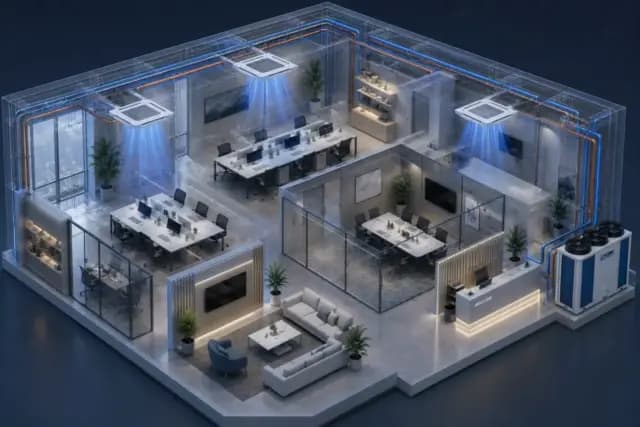 01
01A building on chilled water
Flow and return run from one plant to the air handlers serving every zone.
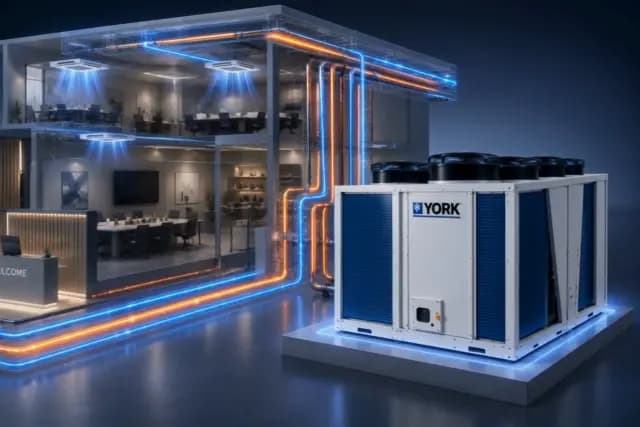 02
02One central plant
The chiller outside carries the whole building rather than a unit per room.
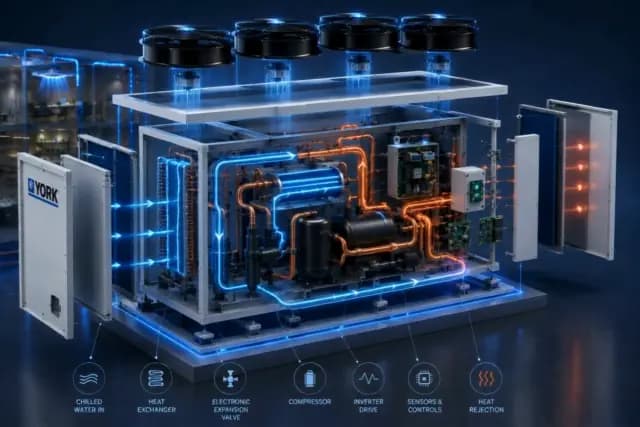 03
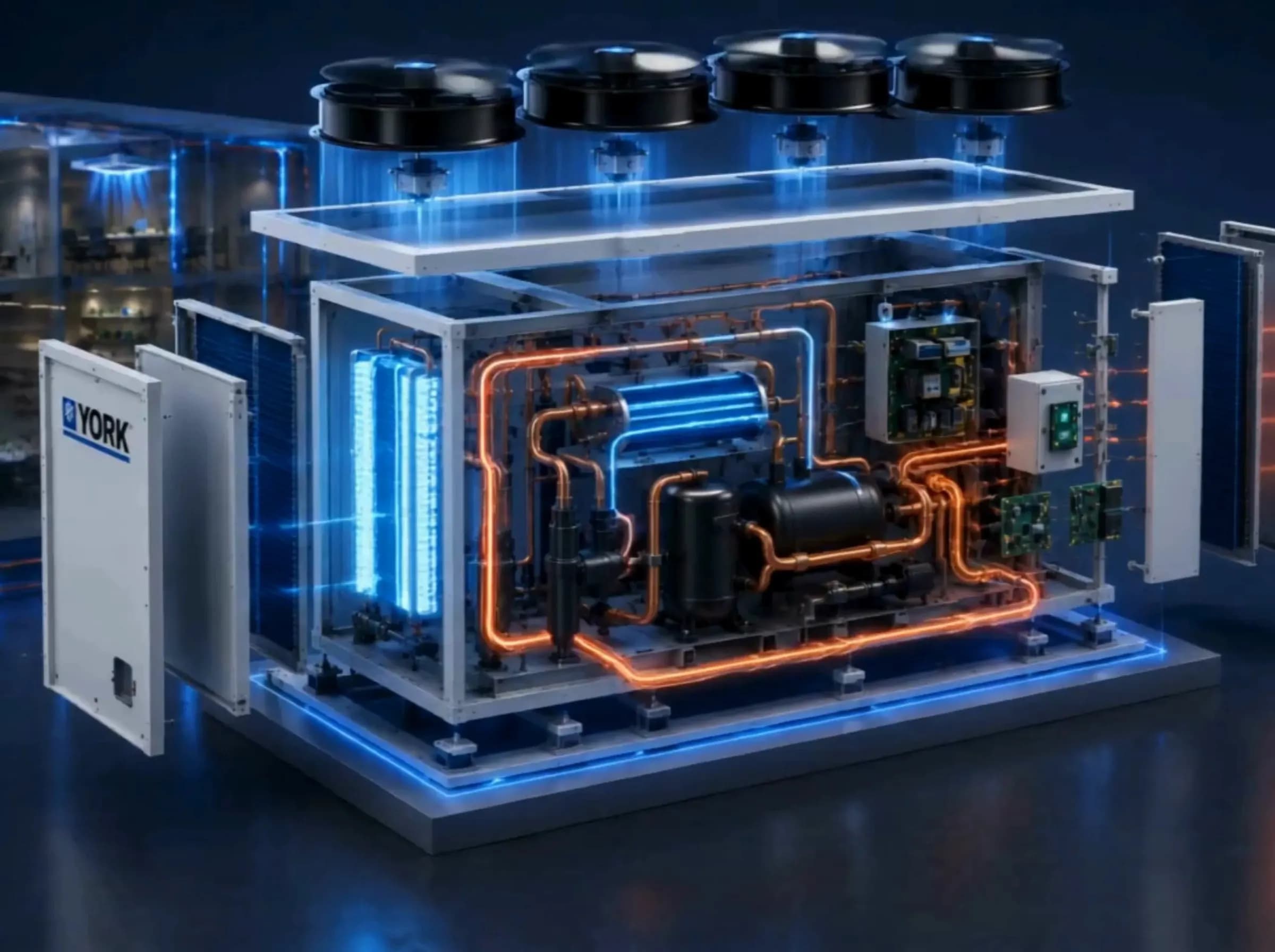
03Inside the chiller
Heat exchanger, compressor, inverter drive and the control boards that trim them.
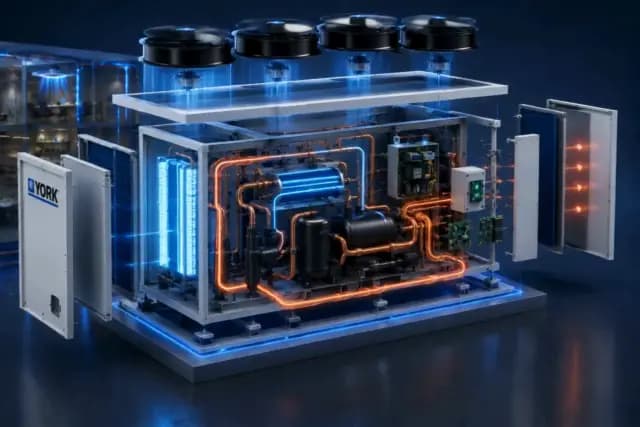 04
04Flow that follows the load
The inverter drive and VFD pumps vary output, so the plant moves only the water it needs.
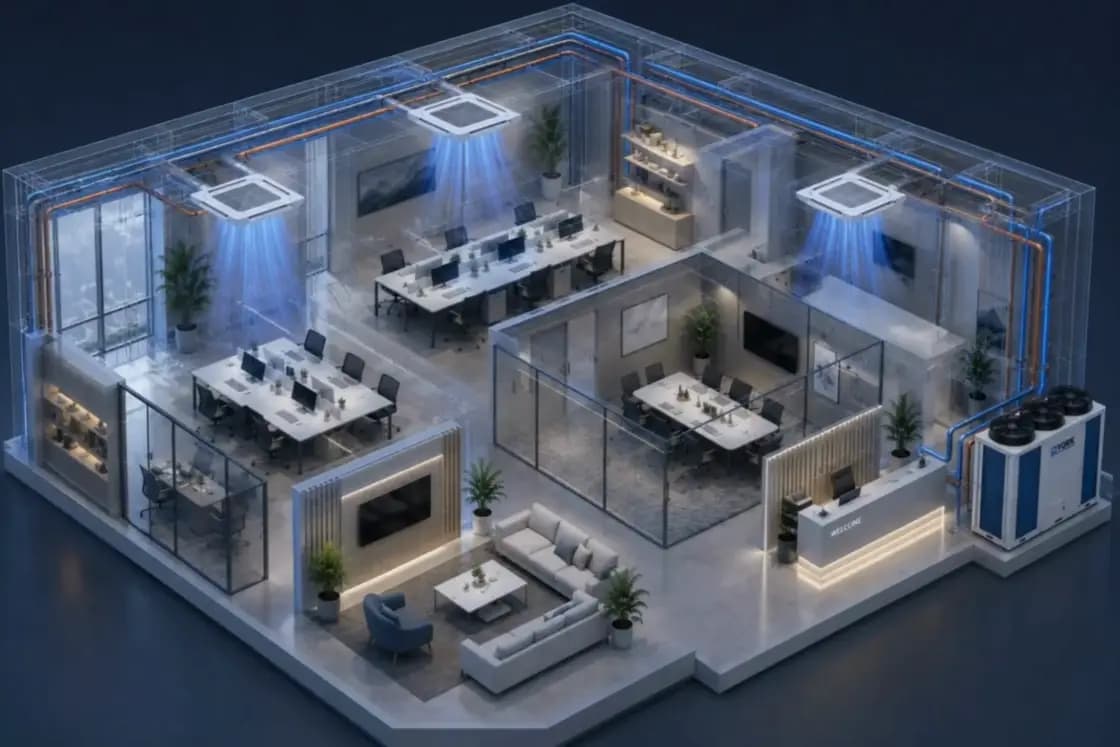
A building on chilled water
Flow and return run from one plant to the air handlers serving every zone.
One central plant
The chiller outside carries the whole building rather than a unit per room.
Inside the chiller
Heat exchanger, compressor, inverter drive and the control boards that trim them.
Flow that follows the load
The inverter drive and VFD pumps vary output, so the plant moves only the water it needs.
The plant only moves the water it needs
Three components work together so flow, not just temperature, tracks the building load.
- 01.
Variable-speed chiller
The compressor and chiller modulate output to the actual load rather than cycling at fixed capacity, holding efficiency from full load down to about 20 percent.
- 02.
Variable-speed pumps
VFD-driven pumps vary water flow instead of running flat out, while 2-way control valves at each AHU and FCU throttle to the demand of the space they serve.
- 03.
BMS control
The building management system reads load and trims flow and temperature continuously, so the plant only moves the water the building actually needs.
VRF vs VWF Financial & Lifecycle Analysis
A real-world residential project ROI comparison evaluating capital cost, electrical infrastructure savings, running cost, AMC and 20-year net financial advantage.
₹9.48L electrical infra savings offset initial equipment cost gap.
8,100 fewer electricity units + 77% lower AMC expenses every year.
Connected load drops from 57.6 kW to 22.5 kW, downsizing DG & panels.
8 years longer plant life + avoided ₹22.6L year-12 VRF replacement.
Project Financial Comparison Ledger
Case Study Model: 57.6 TR VRF vs 25.0 TR VWF • High-End Residential Villa
| Financial & Technical Particulars | VRF SystemStandard DX (57.6 TR) | VWF SystemChilled Water (25.0 TR) | VWF Advantage / Delta |
|---|---|---|---|
| 01. Capital Expenditure & Infrastructure (Capex) | |||
| Equipment Capex | ₹37,69,443 | ₹48,06,281 | +₹10,36,838Higher initial plant equipment |
| Electrical / DG / Panel / Cable Savings | ₹0 (Baseline) | ₹9,47,700 | ₹9,47,700 Savedvia 35.1 kW electrical load reduction |
| Effective Net Capital GapFully recovered in 5.1 months | ₹37,69,443 | ₹38,58,581 | Only ₹89,138 gap |
| 02. Annual Operating & Maintenance Expenditure (Opex) | |||
| Connected Electrical Load | 57.6 kW | 22.5 kW | 35.1 kW Lower61% reduction in utility demand |
| Annual Electricity Consumption | 81,000 units | 72,900 units | 8,100 units SavedPart-load hydronic efficiency |
| Annual Electricity Cost (@ ₹13/unit) | ₹10,53,000 / yr | ₹9,47,700 / yr | ₹1,05,300 / yr SavedRecurring annual energy bill reduction |
| Annual Comprehensive AMC (Year 2 Onward) | ₹2,41,920 / yr (₹4,200/TR) | ₹55,000 / yr (₹2,200/TR) | ₹1,86,920 / yr Saved77% lower AMC expenses |
| Total Ongoing Annual Savings₹33,127 / month recurring benefit | ₹12,94,920 / yr | ₹10,02,700 / yr | ₹3,97,520 / yr Saved |
| 03. 20-Year Lifecycle & Asset Longevity | |||
| Expected System Operational Life | 12 Years | 20 Years | +8 Years LongerHeavy-duty industrial water chiller design |
| Year 12 Major Mid-Life Refurbishment | ~60% (~₹22,61,666) | ₹0 (Chilled water integrity) | ₹22,61,666 AvoidedNo mid-life capital overhaul required |
20-Year Cumulative Net Financial Advantage Net lifecycle financial benefit | Standard Baseline | ₹99,36,008 Net Gain | ₹99,36,008 (~ ₹1.00 Cr) |
Evaluating VWF vs VRF for Your Upcoming Building?
Our senior HVAC engineers provide project-specific thermodynamic load sizing and 20-year cashflow models.
Where a variable flow plant pays for itself
Central plants spend most of the year at part load. That is exactly where varying the flow and not just the temperature, changes the running cost.
Lower pump energy
Pumping power drops sharply as flow reduces, which is the affinity-law behaviour a constant-flow plant can never take advantage of.
Strong part-load efficiency
Plants run at part load for most of the year. A variable-flow design is at its best in exactly those hours.
Precise temperature control
Stable leaving-water temperature holds set points tighter across the building, which shows up as fewer comfort complaints.
Less wear, longer life
Soft, modulated operation replaces the constant start and stop cycling that shortens the life of fixed-speed plant.
Scales to large loads
The approach is built for big central plants, where the pumping energy is large enough to be worth engineering around.
Heat-recovery option
Rejected heat can be reused for domestic hot water or reheat where the selected equipment supports it.
Buildings served by a central chilled water plant
If the building already distributes chilled water to AHUs and FCUs, VWF is the efficiency upgrade that applies to it.
- Large commercial towers
- Hospitals
- Malls and mixed-use developments
- Corporate campuses
- Hotels
- IT & server rooms
VWF vs VRF
Pick VWF for large central-plant buildings on chilled-water distribution. Pick VRF for zoned, distributed comfort without a central plant.
| Attribute | VWFVariable Water Flow | VRFVariable Refrigerant Flow |
|---|---|---|
| What varies | Chilled-water flow | Refrigerant flow |
| Operating pressure | Low-pressure chilled water | High-pressure refrigerant gas |
| Plant type | Central chilled-water plant, chiller plus AHUs and FCUs | Distributed outdoor and indoor units |
| Best fit | Large, high-load buildings | Small to large zoned buildings |
| Main energy lever | Pump and chiller part-load performance | Zoning and heat recovery |
| Footprint | Plant room plus pumps | Compact, no plant room |
| Zoning | Via AHUs and FCUs | Per indoor unit |
Everything You Need to Know
About Variable Water Flow
Sizing a central chilled-water plant?
Request a site survey and we will model the load and design the VWF system around it, rather than around a catalogue.